
One of the most common questions I hear from clients is, "What's the difference between an acknowledgment and a jurat?" It's an important question because although both are common notarial acts, they serve very different legal purposes.
Whether you're signing estate planning documents, real estate paperwork, business agreements, or court forms, understanding the difference can help ensure your documents are completed correctly and accepted the first time.
At Matt Miller Mobile Notary, I perform acknowledgments and jurats every day for clients throughout San Francisco and the Bay Area. Here's what you need to know before your next notarization.
What Is a Notary Acknowledgment?
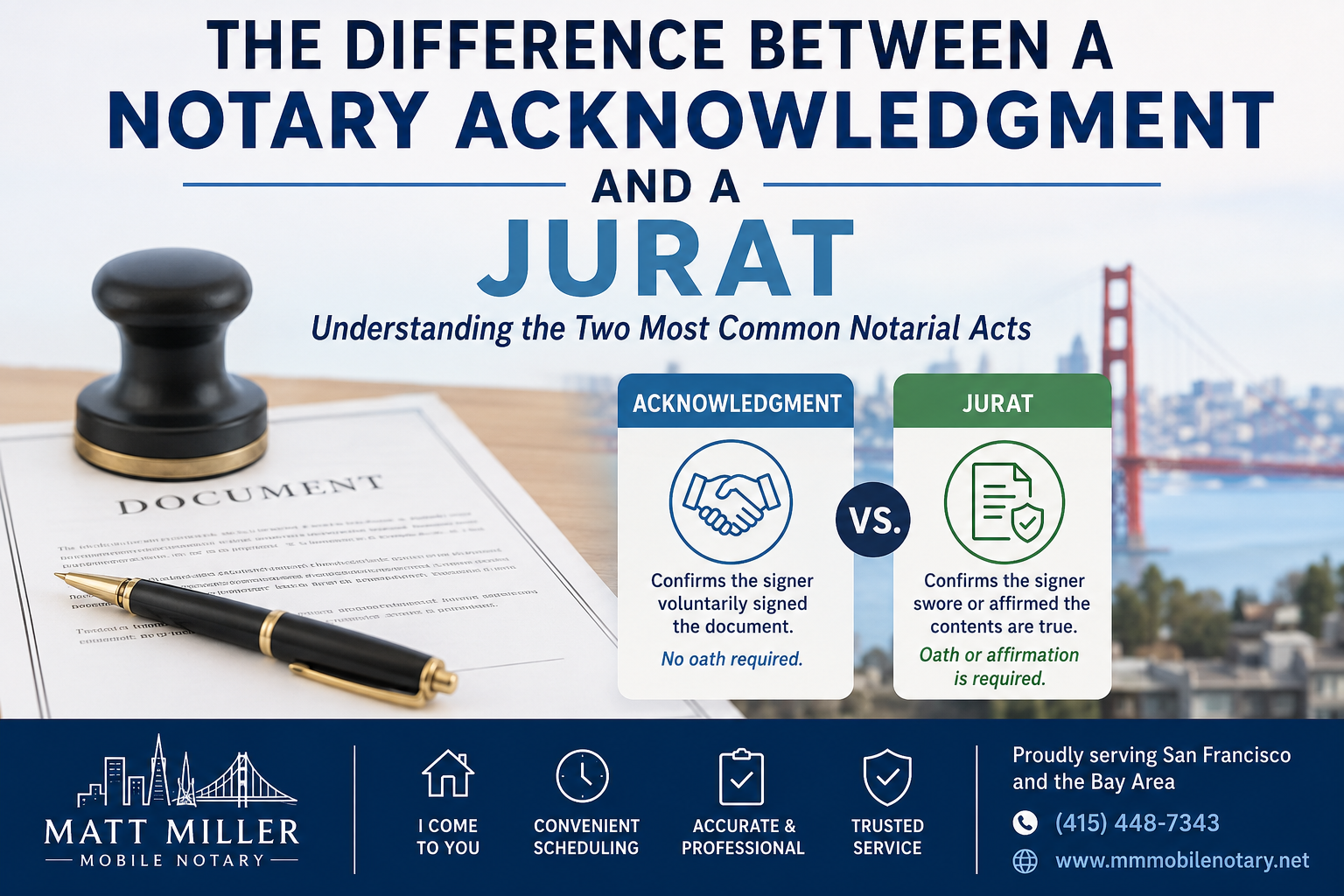
An acknowledgment is used when a signer wants to confirm that they voluntarily signed a document.
During an acknowledgment, the signer personally appears before the notary and acknowledges that the signature on the document is theirs and that they signed the document willingly.
One important point surprises many people:
The document may already be signed before meeting the notary.
Because the purpose of an acknowledgment is to verify the identity of the signer and their voluntary execution of the document, California law does not require the signer to sign the document in the notary's presence.
Common Documents That Require an Acknowledgment
Acknowledgments are frequently used for:
Grant deeds
Quitclaim deeds
Trust documents
Powers of attorney
Real estate documents
Business agreements
Property transfer documents
These documents often become part of the public record or involve significant legal rights, making identity verification especially important.
What Is a Jurat?
A jurat serves a different purpose.
With a jurat, the signer is swearing or affirming that the contents of the document are true.
Unlike an acknowledgment, a jurat requires several additional steps.
The signer must:
Personally appear before the notary.
Sign the document in the notary's presence (or acknowledge a signature made immediately before the notary).
Take an oath or affirmation administered by the notary.
The oath or affirmation is a legally significant statement that the contents of the document are truthful. Providing false information after taking an oath may carry legal consequences.
Common Documents That Require a Jurat
Jurats are commonly used for:
Affidavits
Sworn declarations
Depositions
Court filings
Certain government forms
Statements made under penalty of perjury
If your document contains language stating that the signer is declaring or swearing that the information is true, a jurat may be required.
The Key Differences
Acknowledgment Jurat
Verifies the signer's identity and voluntary signature. Verifies the signer's identity and requires an oath or affirmation
Document may already be signed Document is generally signed in the notary's presence
No oath or affirmation Oath or affirmation is required
Common for deeds, trusts, and powers of attorney Common for affidavits and sworn statements
Who Decides Which Notarial Act Is Needed?
This is another question clients ask frequently.
The answer is simple:
The notary cannot choose for you.
California notaries are prohibited from giving legal advice or deciding which notarial act is appropriate unless the document clearly indicates the required certificate.
If the document does not specify whether an acknowledgment or jurat is needed, you should contact:
The attorney who prepared the document
The agency requesting the document
The title company
The receiving government office
If you're unsure, I'm always happy to explain the differences between the available notarial acts, but I cannot legally recommend one over the other.
How a Mobile Notary Makes the Process Easier
Many people assume they have to interrupt their day to visit a bank or shipping store for notarization.
With a mobile notary, the process comes to you.
Whether you're signing documents at:
Your home
Your office
A hospital or rehabilitation facility
A senior living community
A law firm
A title or escrow office
Another convenient location
I bring everything needed to complete your notarization professionally and efficiently.
This is especially valuable for estate planning clients, busy professionals, real estate transactions, and families handling time-sensitive documents.
Why Accuracy Matters
Choosing the wrong notarial certificate can delay a real estate closing, cause a government agency to reject your paperwork, or require you to schedule another appointment.
Working with an experienced mobile notary helps ensure the notarization is completed correctly while complying with California law.
At Matt Miller Mobile Notary, I take the time to verify identification, explain the notarization process, and complete every appointment with professionalism and attention to detail.
Whether you need a single document notarized or multiple signers accommodated, my goal is to make the experience convenient, efficient, and stress-free.
Schedule Your Mobile Notary Appointment
If you need an acknowledgment, a jurat, or another notarial service, I'm here to help.
Matt Miller Mobile Notary proudly serves individuals, families, attorneys, real estate professionals, businesses, hospitals, and care facilities throughout San Francisco and the surrounding Bay Area.
Mobile Notary Services Include:
Acknowledgments
Jurats
Estate planning documents
Powers of attorney
Real estate and loan signings
Hospital and care facility notarizations
Apostille services
Mobile ink fingerprinting
Call or text: (415) 448-7343