San Francisco's Choice Notary & Fingerprint Service Provider
penfavcon.png

Mobile Notary Blog


How to Get a Power of Attorney Notarized in San Francisco

If you're planning ahead for a medical emergency, financial delegation, or estate planning, a Power of Attorney (POA) is one of the most important legal tools you can have. But before a POA becomes valid and enforceable in California, it must be notarized. In this article, we’ll walk you through exactly how to get a Power of Attorney notarized in San Francisco—quickly, correctly, and with peace of mind.

What Is a Power of Attorney?

A Power of Attorney is a legal document that grants someone (called an “agent” or “attorney-in-fact”) the authority to make decisions on your behalf. POAs can cover financial matters, healthcare decisions, or both. California recognizes several types of POAs, including:

  • General Power of Attorney

  • Durable Power of Attorney

  • Springing Power of Attorney

  • Medical Power of Attorney (Advance Healthcare Directive)

To be legally effective, most POAs must be either notarized or signed in the presence of two witnesses—often both.

Why Notarization Is Important

Notarization adds a layer of authenticity and helps prevent fraud. When a notary public notarizes a POA, they:

  • Verify the signer’s identity using valid photo ID

  • Ensure the signer is willing and understands what they are signing

  • Complete a California acknowledgment certificate to make the document valid

In some cases, especially when the POA will be used with banks, title companies, or government agencies, notarization is mandatory.

How to Prepare for POA Notarization in San Francisco

If you're in the Bay Area, here’s what you need to do:

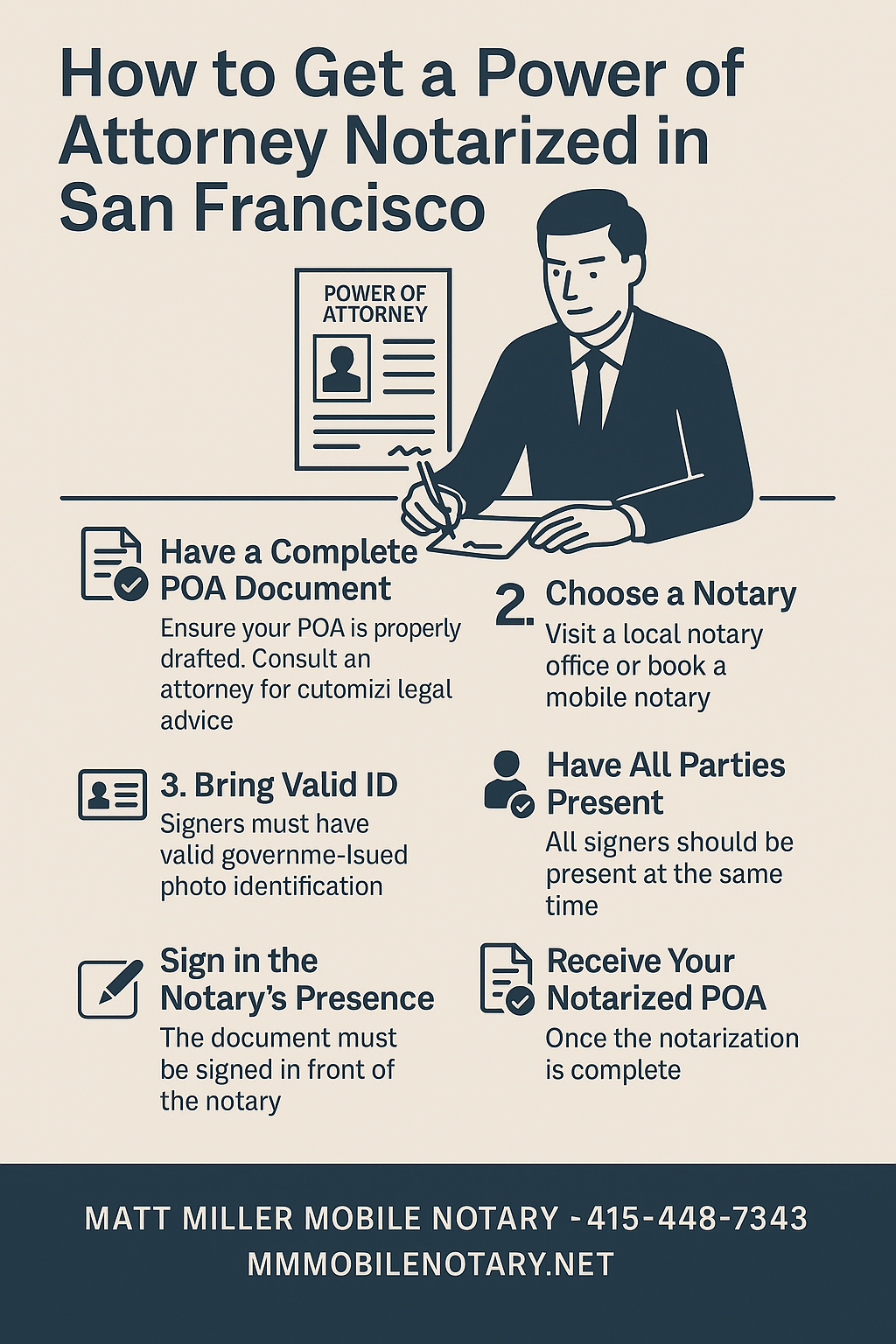
1. Have a Complete POA Document

Make sure your POA is properly drafted. You can use templates, but it’s wise to consult with an attorney for customized legal advice, especially for durable or springing POAs.

2. Choose a Notary

You can visit a local notary office or book a mobile notary to come to your home, office, hospital, or care facility. Matt Miller Mobile Notary offers flexible hours and same-day appointments throughout San Francisco.

3. Bring Valid ID

All signers must have valid, government-issued photo identification such as a California driver’s license or passport.

4. Have All Parties Present

If more than one person is signing (e.g., you and your agent), all signers should be present at the same time. Some powers of attorney documents also require witnesses, which you should arrange in advance.

5. Sign in the Notary’s Presence

The document must be signed in front of the notary, unless it was already signed and the notary performs an acknowledgment (as allowed in California).

6. Receive Your Notarized POA

Once the notarization is complete, the notary will attach a notarial certificate and stamp the document. You’ll receive the notarized POA right away, ready for use.

Special Considerations in San Francisco

  • Hospitals and Care Facilities: Many POAs are signed in medical settings. A mobile notary like Matt Miller Mobile Notary can meet you at UCSF, Zuckerberg San Francisco General, or any other hospital often the same day.

  • Real Estate POAs: If your POA involves real estate transactions, make sure it meets California Civil Code § 4121 requirements.

  • Multilingual Needs: If the signer doesn’t speak English, a notary who speaks the signer’s language will need to be sourced. CA law mandates that the signer and the notary must be able to communicate directly, no interpreters are allowed.

Why Choose a Mobile Notary?

Life doesn’t stop for paperwork. A mobile notary brings professionalism, flexibility, and convenience directly to your doorstep. Whether you’re at home, in a care facility, or managing an urgent situation, we make the notarization process seamless and stress-free.

Need a Power of Attorney notarized in San Francisco?

Contact Matt Miller Mobile Notary at 415-448-7343 or book online for fast, friendly, and reliable service wherever you are in the city.


How to Get an Apostille in San Francisco

If you're dealing with international paperwork—such as getting married abroad, studying overseas, or conducting business in another country—you may need an apostille. An apostille is a special certificate issued by the Secretary of State that verifies the authenticity of a notarized or government-issued document for use in countries that are part of the Hague Apostille Convention.

In San Francisco, the process of obtaining an apostille can be confusing if you’ve never done it before. This article will guide you step-by-step through what you need, where to go, and how to make the process faster and easier—especially with the help of a mobile notary.

Step 1: Determine if You Need an Apostille

First, confirm that the document will be sent to a country that’s a member of the Hague Apostille Convention. If not, you may need a different type of authentication process known as legalization, which often includes going through the destination country’s consulate.

Some common documents that often require apostilles include:

  • Birth, marriage, or death certificates

  • Power of attorney documents

  • Academic transcripts or diplomas

  • Articles of incorporation or other business records

  • Adoption dossiers

  • Background checks (e.g., FBI or DOJ reports)

Step 2: Notarize the Document (If Required)

Most documents must be notarized before they can be apostilled, unless they are already official government documents (like vital records or court documents).

You’ll need a California Notary Public to notarize:

  • Power of Attorney

  • Affidavits

  • Permission to Travel Letters

  • Business documents

  • Copies of diplomas or transcripts (only with a properly worded affidavit)

A mobile notary in San Francisco can meet you at your home, office, or any convenient location to notarize the document quickly and correctly.

Step 3: Submit to the California Secretary of State

Once your document is notarized (or if it's an official public document), it must be sent to the California Secretary of State’s office in Sacramento or Los Angeles for the apostille to be issued.

You have three options:

A. Mail-In Submission

Send your document, a completed Apostille Request Form, and a check or money order ($20 per apostille) to:

California Secretary of State – Apostille
1500 11th Street, Sacramento, CA 95814

Processing times vary but usually take 1–2 weeks.

B. Walk-In Service (Sacramento or Los Angeles)

If you need your apostille urgently, you or your courier can visit one of the two offices in person. This allows for same-day processing in many cases.

C. Use a Courier or Apostille Service

Hiring a San Francisco apostille agent or mobile notary can simplify the process. These professionals can notarize your document, ensure it's correctly prepared, and submit it for apostille processing on your behalf.

Why Use a Mobile Notary for Apostille Services?

Working with a mobile notary or apostille specialist in San Francisco offers several advantages:

  • Convenience: We come to you—home, office, or public location.

  • Accuracy: We make sure your documents meet all California and international requirements.

  • Speed: We can help expedite processing through hand delivery and retrieval.

  • Peace of Mind: Avoid costly mistakes or rejected applications.

Final Thoughts

Getting an apostille in San Francisco doesn’t have to be a hassle. With the right guidance—and help from a knowledgeable mobile notary—you can get your documents authenticated properly and on time.

If you need help with notarization, document preparation, or submitting your documents for an apostille, Matt Miller Mobile Notary is here to help. We specialize in making the process fast, easy, and stress-free.

📞 Contact us today to schedule a mobile notary appointment or apostille service in San Francisco.

Top 5 Reasons to Use a Mobile Notary in San Francisco

When life gets busy, taking time out of your day to find and visit a notary can feel like an unnecessary hassle. That’s where mobile notaries come in — professionals who bring the notary office to you. In a city like San Francisco, where time is money and convenience is king, using a mobile notary isn't just smart — it's often the best choice.

Whether you're handling a legal matter, finalizing a real estate deal, or securing a travel authorization for a child, here are the top five reasons San Franciscans are turning to mobile notaries.

1. Convenience That Comes to You

A mobile notary travels to your home, office, hospital room, or even your favorite coffee shop. No more rearranging your schedule, fighting through traffic, or searching for parking downtown. With mobile notarization, the appointment happens when and where it works best for you — mornings, evenings, weekends, or even same-day.

2. Ideal for Busy Professionals

In San Francisco, the pace is fast — tech workers, attorneys, and entrepreneurs often don't have the time to leave work for errands like notarization. Mobile notaries understand the importance of time, offering flexible hours and on-site service to keep your day moving. You don’t need to stop working to get your documents handled.

3. Critical for Medical or Emergency Situations

Mobile notaries play a vital role for those in hospitals, care homes, or hospice. When powers of attorney, healthcare directives, or other critical documents need notarization, time is often of the essence. A mobile notary ensures you or your loved one can get legally binding documents completed without added stress — right from a hospital bed or care facility.

4. Reliable for Real Estate Closings

Real estate transactions often require multiple notarized documents — and mobile notaries are trained and certified to assist with these high-stakes signings. From buyers and sellers to agents and escrow officers, everyone benefits when the notary shows up on time and knows the paperwork inside out. Mobile notaries in San Francisco are often NNA-certified signing agents with the credentials to get it done right.

5. Flexibility and Personal Service

Unlike walk-in notary services, mobile notaries offer a more personal touch. You’ll often work with the same notary for multiple signings, and they’ll take the time to walk you through the process. Whether you need documents in English or have special circumstances, a mobile notary’s flexibility makes them an essential part of your legal and business toolkit.

Ready to Book a Mobile Notary in San Francisco?

At Matt Miller Mobile Notary, we provide professional, reliable, and flexible notary services throughout San Francisco and the surrounding Bay Area. From last-minute appointments to complex signings, we’re here to make the notarization process easy and stress-free.

📞 Call or text today to schedule your appointment.

Matt MillerComment
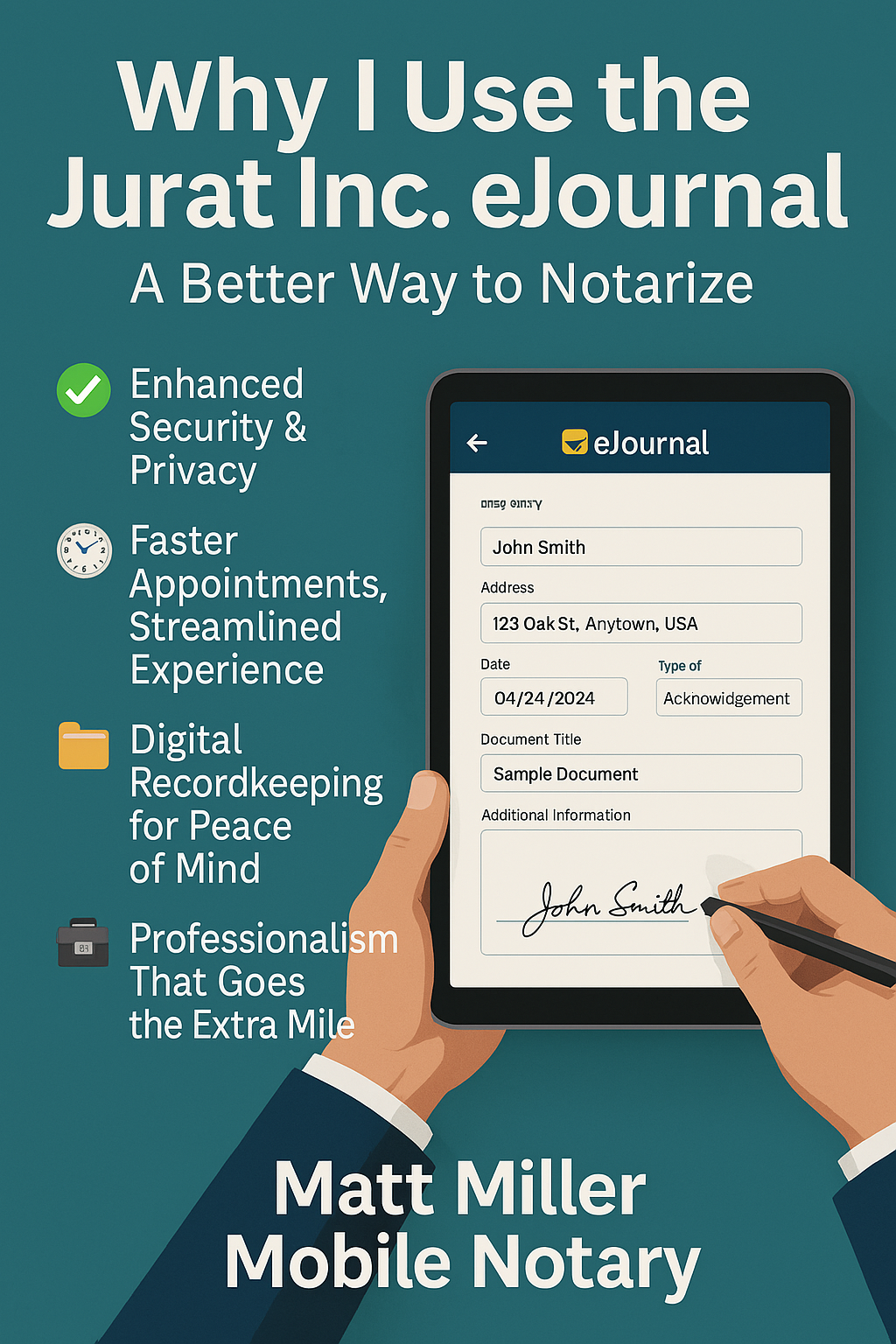
Why I Use the Jurat Inc. eJournal: Setting a Higher Standard for Mobile Notary Services

As a professional mobile notary, I understand that trust, accuracy, and efficiency are the foundations of exceptional service. That’s why I’ve invested in tools that help me deliver a better, more secure experience for my clients—starting with the Jurat Inc. eJournal.

In an industry where details matter, the Jurat Inc. eJournal sets me apart from notaries who still rely on paper logs and manual tracking. Here’s how this innovative technology benefits you, the client—and why it’s a key part of my commitment to excellence

✅ Enhanced Security & Privacy

Your sensitive information deserves the highest level of protection. The Jurat Inc. eJournal uses encrypted cloud storage and secure authentication protocols to safeguard every journal entry. Unlike traditional paper logs, there’s no risk of lost or damaged books—and your records are never left vulnerable in a car or briefcase.

🕒 Faster Appointments, Streamlined Experience

The eJournal allows me to complete entries quickly and accurately in real time, reducing wait times and eliminating paperwork hassles. Signers can even sign directly on my device, saving you time and making your appointment smoother from start to finish.

📁 Digital Recordkeeping for Peace of Mind

Each notarization I perform is backed by a complete, tamper-proof digital log. If you ever need to verify or retrieve a record, it’s available and traceable—no digging through old paper logs or worrying about incomplete entries. That means fewer errors, better compliance, and total transparency.

🧰 Professionalism That Goes the Extra Mile

Using the Jurat Inc. eJournal isn’t just about tech—it’s about raising the bar. It shows that I care about doing things the right way, with attention to detail and modern best practices. When you hire Matt Miller Mobile Notary, you’re choosing someone who’s prepared, punctual, and dedicated to getting it right the first time.

🌐 Future-Ready Notary Services

In a world that’s going increasingly digital, clients expect secure and seamless solutions. Whether I’m meeting you at your home, office, hospital, or coffee shop, my mobile notary setup is equipped to handle the demands of today—and tomorrow.

Ready to book a notary who brings professionalism and tech-savvy service to your door? Contact me today and experience the difference of working with a mobile notary who values both tradition *and* innovation.

Types of Documents Notarized

Notarization is the process of authenticating a document by a notary public, a public officer who witnesses the signing of a document and verifies the identity of the signer. Notarization is often required for legal or financial transactions, and can help prevent fraud by providing an independent third-party verification of the authenticity of the document.

There are many types of documents that are commonly notarized, including:

Real estate documents: When buying or selling a property, it is common for documents such as deeds, mortgages, and titles to be notarized. This helps to ensure that the transaction is legally valid and can help prevent disputes over ownership of the property.

Financial documents: Financial documents such as loans, contracts, and power of attorney documents are often notarized to protect the interests of all parties involved. For example, a mortgage document may be notarized to confirm that the borrower has signed the document willingly and understands the terms of the loan.

Legal documents: Many legal documents, such as trusts, affidavits, and health care directives require notarization to be legally binding. This helps to prevent fraud and ensures that the document was signed willingly and with proper understanding of the terms.

Travel documents: Some travel documents, such as passport and visa requests, may require notarization to confirm the identity of the applicant and prevent fraud.

Business documents: Business documents, such as contracts and agreements, may be notarized to protect the interests of all parties involved and ensure that the terms of the document are legally binding.

In general, any document that requires legal or financial transactions or that involves the transfer of money or property may be notarized. It is important to consult with a legal professional or the appropriate government agency to determine if a document needs to be notarized and how to properly notarize it.

The #1 Key to Success as a Mobile Notary & Loan Signing Agent

Frequently I hear the same question being asked by new notaries and notaries who want to take their business to the next level, what is the one thing that I can do to get more customers? The answer is often overlooked, telephone etiquette. The telephone is one of the most important and commonly used tools in business. Multitudes of businesses, companies, and individuals use telephones in their work every day; however, most of us don’t think of the telephone as a tool, and as a result, inadvertently misuse it. The telephone is a link between us and the world outside our business. Unfortunately, sometimes we don’t pay attention or make a conscious effort to monitor what kind of message we are sending to our callers and the outside world. Below are some tips to help you use this invaluable tool to your advantage.

Some basic rules of telephone etiquette are. . .

• Always try to answer your phone whenever possible
• Always practice answering your phone within 3 rings
• DO NOT eat or chew gum while talking on the phone
• DO NOT carry on a conversation with another person while on the phone
• Always be courteous and professional
• Always make the other person feel important
• Manage expectations, be honest and don’t over-promise or under-deliver
• Project a positive, enthusiastic, and friendly attitude
• Appreciate a person’s time and respect it as valuable

When Answering the telephone. . .

• Smile when answering the phone (callers can “hear” your smile)
• Use a friendly greeting, “Good morning” or “Good afternoon”
• Be polite, “Thank you for calling My Mobile Notary Business”
• Identify yourself, “‘This is Matt speaking”
• Offer assistance, “How can I help you?”
• Stay positive, be considerate, show interest, and care

While Speaking with Customers on the telephone. . .

• Speak directly into the mouthpiece of your phone or a headset while talking
• Be polite and kind (use phrases like, Please and Thank You)
• Listen without interrupting
• Word distinction should be clear and easy to understand; enunciate your words
• Control your rate of speech; do not speak too fast
• Respond with appropriate emotion
• Avoid being condescending, even if you are asked silly questions
• Use the other person's name often, people like to hear their name
• Take time with everyone and do not rush someone off the phone
• Offer referrals when you can’t help, don’t just say no
• Who should hang up first? Let the person calling hang up first

When you can’t answer the telephone. . .

• Avoid using the "system greeting"; record a personal greeting and keep your message up-to-date
• Make sure your voicemail greeting is clear, effective, and friendly
• Do not repeat yourself (state information one time)
• Keep greetings as brief and concise as possible
• Give the caller options “You may also send a text or visit my website for more info”
• At the end of the message, thank the caller for reaching out and tell them when they can expect your return call
• Keep your voicemail box empty (Check your voicemail often and return calls promptly, even when you can’t help)

When returning a Telephone call. . .

• Prepare yourself. Visualize your caller as a friendly, positive person
• Assume what questions or objections you may encounter before placing the call and have answers ready
• State your objectives upfront to identify the information you need to obtain from the conversation
• Take mental notes during the call
• Specify any follow-up action to the caller
• State the action you will take
• Thank them for calling and say “Good-bye”

Proper Telephone Language. . .

• Ask don’t tell, “I am having a little difficulty hearing you. Can you please speak up?”
• Refrain from using slurs, slang, or phrases, such as, “bye-bye,” “Okie-Dokie,” or, “Alrighty”
• Don’t begin sentences with phrases like, “You have to-,” You need to-“, or, “Why didn’t you?”
• Never refer to a matter as, “Your problem” or “Your issue”
• Identify inquiries as, “Your question,” “Your concern,” or, “This situation”
• Never reply with remarks like, “I can’t do that” or, “that’s not my job”

The telephone is a critical element to success. Initial contact with your customers is most frequently made through a telephone call. Your customers are the reason your business exists and the telephone is the main link to your customers. Your role in answering the phone is vital in satisfying customer needs, delivering the highest quality of service, and building your business every day.

Swearing in Ceremony for New CA Attorneys

One of the first things you may choose to do once you pass the California Bar Examination is to attend a swearing-in ceremony where large groups of attorneys take the attorney oath at the same time. Taking the oath is not just a ritual, it is required for admission to practice law in the state of California.  But due to the COVID-19 pandemic and in an effort to keep everyone safe, all swearing-in ceremonies have been cancelled. However, there are a number of officials in California who are authorized to administer the oath, including Notaries!

If you passed the California Bar Exam, congratulations! If you have met all other requirements, you are now ready to take the attorney's oath. You will soon receive more details about your State Bar license and how to proceed with enrollment. Once you have received your oath package, you are ready to be sworn-in. To do so, please make sure you have filled out your oath card completely. Next, schedule your swearing in ceremony here. A commissioned, bonded and insured California Notary Public will come to you at your location, swear you in and, sign your oath card which can then be mailed to the CA State Bar Association specifically to the address on the card.

That’s it! It’s that easy. Don’t wait and see if swearing in ceremonies resume later this year, take your oath now and get ahead of the pack! To find a mobile notary in your area, search “mobile notary services” and your city and state.